
IN REMEMBRANCE • 1930–2026
Dolores Huerta | A Lifetime of Purpose
Remembering an American icon whose presence, accessibility, and commitment to others inspired generations.
Article and Photos by
Richard Sandoval
 n Wednesday, October 28, 2026, America lost one of its most influential civil rights leaders. Dolores Huerta passed away at the age of 96, leaving behind a remarkable legacy of activism, leadership, and service.
Throughout yesterday afternoon, my social media feeds were filled with what seemed like thousands of photographs, personal memories, and remembrances of Dolores Huerta.
What struck me wasn’t simply the number of people sharing their experiences. It was the remarkable accessibility of a woman who had helped shape American history.
We live in an age when nearly everyone carries a camera in their pocket. Over the years, countless people had the opportunity to meet Dolores, exchange a few words, pose for a photograph, or record a moment on their phones and yesterday, many of those moments became part of a collective remembrance.
Looking through those photographs, I was reminded that many of the people sharing them understood something significant: they had stood alongside, spoken with, or shared a moment with a civil rights leader whose contributions were woven into our nation’s history.
Not everyone has the opportunity to meet someone whose life and work will be studied by future generations. Yet Dolores Huerta made herself remarkably accessible to people from all walks of life.
Some of the images were from prestigious celebrations. Others came from schools, community gatherings, conferences, and neighborhood events.
Together, they revealed something that awards and historical accounts alone cannot fully capture: the personal connections she made throughout a lifetime of public service.
I found myself reflecting on my own experiences.
Over the years, I had the opportunity to meet, interview, and photograph Dolores Huerta on numerous occasions.
Living and working in California, particularly while documenting the Hispanic community, it was difficult to attend a major gathering without seeing Dolores either participating, being recognized, or encouraging others to become involved.
From red carpets and prestigious celebrations to high schools and small community gatherings, she was seemingly everywhere and regardless of the size of the gathering, she had a message to share.
The Power of Being Present
I want to be clear. I did not know Dolores Huerta personally. My observations come from nearly three decades of encountering her through my work as a journalist, photographer, and storyteller.
I believe I first met her sometime in the late 1990s or early 2000s.
By then, I was certainly familiar with her contributions to the farmworker movement and her place in California history.
You couldn’t help but recognize that you were in the presence of someone who had helped shape not only California, but the nation.
Yet something else stood out.
Despite the recognition, awards, and attention she received, Dolores seemed to possess an extraordinary ability to approach people and make them feel comfortable.
Whether speaking to elected officials, students, community organizers, or someone asking for a photograph, she appeared genuinely interested in the people around her.
That is something I always admired.
There was a certain accessibility about her, an ability to connect with people without allowing her reputation or accomplishments to become a barrier.
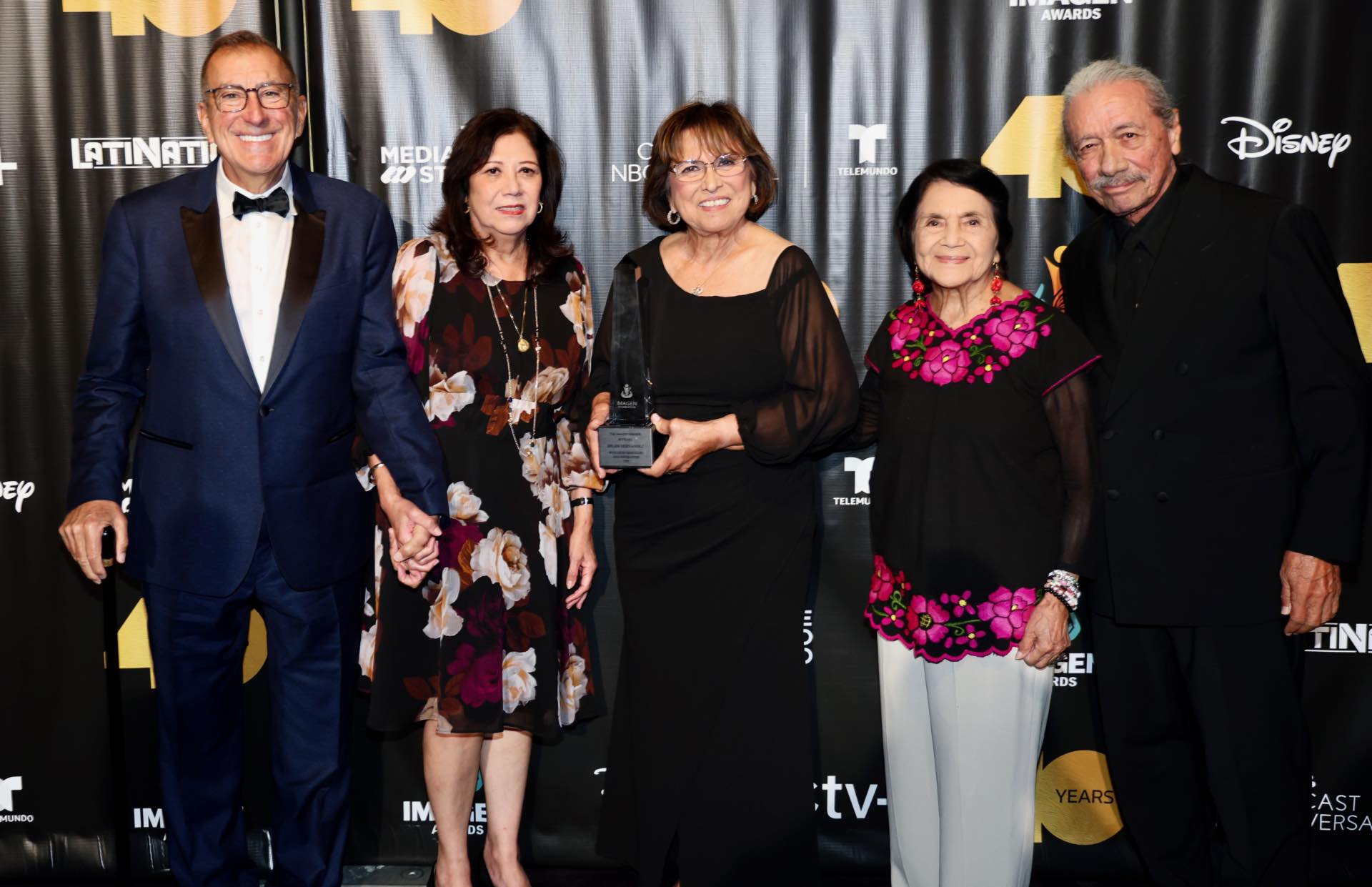
2025 Red Carpet Moments | 40th Annual Imagen Awards Awards
Appearing in the photo, Kenny Ortega, Los Angeles County Supervisor Hilda Solis, Helen Hernandez, Dolores Huerta, Edward James Olmos
A Life That Changed History
Born April 10, 1930, in Dawson, New Mexico, Dolores Huerta grew up in California’s Central Valley. She began her professional career as a teacher before dedicating herself to improving the lives of farmworkers and their families.
In 1962, she co-founded the National Farm Workers Association with César Chávez, an organization that would eventually become the United Farm Workers.
Her leadership helped advance labor protections, collective bargaining rights, and improved working conditions for agricultural workers. She played a significant role in the Delano grape strike and the nationwide boycotts that brought attention to the circumstances facing farmworker families.
Her work extended far beyond the agricultural fields. Over the decades, she advocated for women’s rights, educational opportunities, civic participation, immigrant communities, and greater representation in American society.
Her enduring expression, “Sí, se puede,” became a rallying cry for generations who believed that meaningful change was possible through perseverance and collective action.
Among her many honors was the Presidential Medal of Freedom, awarded by President Barack Obama in 2012.
But perhaps one of her greatest accomplishments was her ability to encourage others to believe that they, too, could make a difference.
The Sacrifices Behind the Recognition
I did not know Dolores during the 1960s or 1970s, when the farmworker movement was taking shape and its organizers confronted enormous obstacles.
Like many of us who came to know her story later, I cannot pretend to fully understand the personal challenges she experienced.
The demands of raising a family, maintaining a livelihood, confronting opposition, and dedicating so much of one’s life to a cause are not things that can be completely understood through photographs, interviews, or historical accounts.
Her life included enormous personal sacrifices, including painful experiences that only became publicly known decades later. Those experiences are also part of her history and deserve to be acknowledged.
What we can recognize is that her commitment extended across generations.
She continued showing up, sharing her experiences, encouraging participation, and reminding people that they had a role to play in their communities.
A Legacy We Can Carry Forward
As I looked through the thousands of photographs and remembrances appearing in my social media feeds, I was reminded that history is not only measured by legislation, awards, or public recognition.
Sometimes it is measured by the way someone makes another person feel.
From my perspective, Dolores Huerta encouraged people to vote, stand up for what they believed in, and use whatever abilities or opportunities they possessed to make a positive impact.
You didn’t need to be famous, wealthy, or hold public office to contribute something meaningful.
You simply needed to care enough to participate.
And that may be one of the most important lessons she leaves behind.
Her life provides a reference point for what is possible and, in many ways, a playbook for inspiring future generations of leaders.
Those photographs circulating yesterday are more than personal keepsakes. Collectively, they represent generations of people who had an opportunity to connect with someone who helped shape our nation’s history.
They are reminders that history isn’t always something we discover in books or museums.
Sometimes history is standing right next to us, smiling for a photograph, sharing a conversation, or encouraging us to do something meaningful with our own lives.
Dolores Huerta | A Life of Leadership
1930–2026
Dolores Huerta was an American labor leader, civil rights activist, and advocate for women, workers, and underserved communities.
Her contributions and recognition include:
- 1962: Co-founded the National Farm Workers Association with César Chávez, helping establish what became the United Farm Workers.
- 1965–1975: Helped organize farmworker strikes and national boycotts and advocated for California’s Agricultural Labor Relations Act.
- 1993: Inducted into the National Women’s Hall of Fame.
- 1998: Received the Eleanor Roosevelt Human Rights Award.
- 2003: Established the Dolores Huerta Foundation to support grassroots organizing, education, and community leadership.
- 2012: Received the Presidential Medal of Freedom, the nation’s highest civilian honor.
- 2013: Inducted into the California Hall of Fame.
Her legacy continues through the organizations, communities, and generations of leaders influenced by her commitment to civic participation and social change.
EDITOR NOTES
Thank you, Dolores Huerta, for being accessible.
Thank you for sharing your time, your experiences, and your sense of purpose with so many people over the years.
And thank you for reminding us that even those who leave an extraordinary mark on history are human beings walking this earth with ambition, conviction, challenges, and the desire to make life better for the people around them.
I consider myself fortunate to have documented a few moments along your remarkable journey.
Your legacy will continue through the people you inspired, the communities you helped strengthen, and the generations who will discover your story.
Sí, se puede.
I welcome your thoughts, ideas, and suggestions for future stories. Whether it’s a personal experience, an inspiring individual, or an important issue affecting our communities, I’d like to hear from you.
Email me at RDS@HispanicLifestyle.com, connect with @HLTV on Instagram, or follow Richard Sandoval on LinkedIn.
Let’s keep the conversation going.