
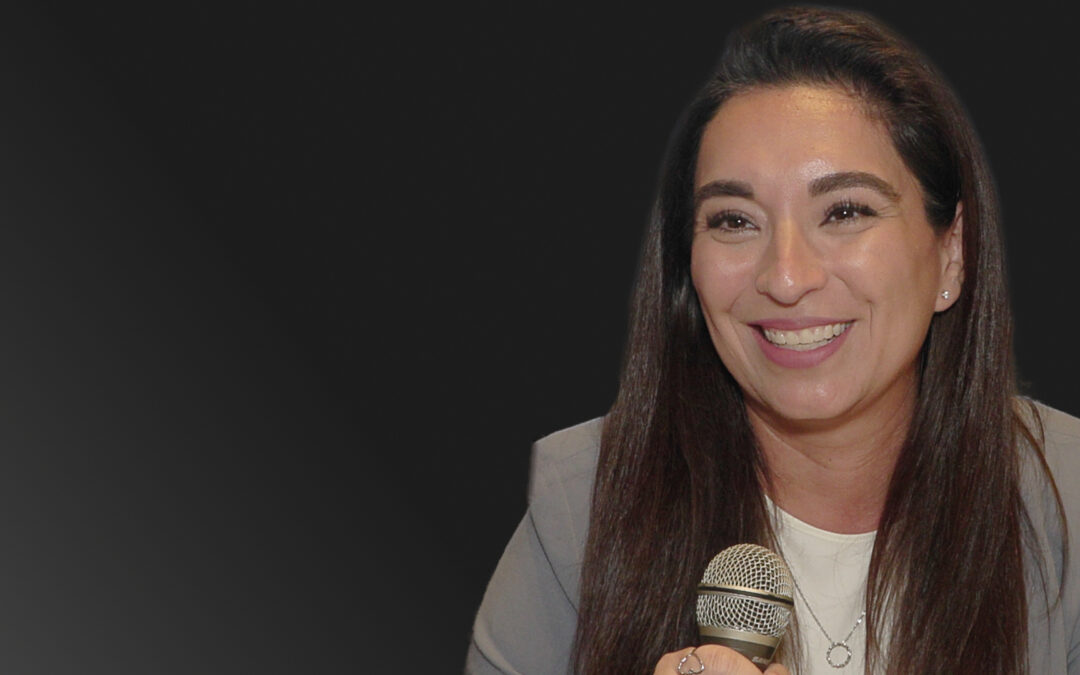
Daniela Mounger | Building a Better Way to Send Money Home

Daniela Mounger | Building a Better Way to Send Money Home

HL INSIGHTS

Daniela Mounger | Building a Better Way to Send Money Home

For Wells Fargo executive Daniela Mounger, the modernization of ExpressSend® is both a business initiative and something deeply personal.

Photos and article by
Richard Sandoval

or Daniela Mounger, sending money across borders is not simply part of her job.  It is part of her life.

Born and raised in Monterrey, Mexico, Mounger moved to the United States 14 years ago. Her parents and much of her family remain in Mexico, and she understands firsthand what it means to stay connected across borders.

She sends money home for birthdays, Mother’s Day, everyday needs and moments when family needs support.

Today, she also leads the Wells Fargo business responsible for helping customers do the same.

Mounger is senior vice president and head of Global Remittance Services within Wells Fargo Consumer Banking and Lending, where she leads the strategy, transformation and growth of ExpressSend®, the company’s cross-border remittance product, along with its consumer foreign-currency solutions.

Hispanic Lifestyle spoke with Mounger during AVANCE Global in Las Vegas about the evolution of ExpressSend, the changing expectations of customers and why the work carries such personal meaning for her.

Listening to the customer

ExpressSend has been around for more than a decade, but the way customers use it has changed significantly.

For years, customers were often directed to Wells Fargo branches to manage aspects of the international money-transfer process.

Mounger said customers were asking for something easier.

“We listened to them,” she said. “They asked us to innovate. They asked us to have a convenient way to send money from their mobile apps.”

That feedback helped drive the modernization of ExpressSend and its nationwide launch within the Wells Fargo Mobile® app.

The mobile experience allows customers to add and manage recipients, track transfers and receive alerts directly through the app. Wells Fargo says ExpressSend currently supports transfers to 12 countries.

For Mounger, the convenience is important because it reflects the way people live now.

“All of us are attached to our mobile phones,  nuestros celulares,” she said.

The ability to send money from a phone can matter in ordinary moments as much as emergencies.

Someone may be thinking about a parent, an aunt or another family member back home. A birthday may be coming up. A relative may need help.

“You just pull out your phone,” Mounger said.

More than a product

What makes Mounger’s connection to ExpressSend different is that she is not only leading the product.

She uses it.

“I’m Mexican, born and raised in Monterrey, Mexico, and my parents are still there. My family is still there,” she told HL Media Network.

She uses the service to send money to her parents and family members for occasions that are both important and routine.

“I use it to send money to my parents when they need it,” she said. “I use it for Mother’s Day, my mom’s birthday, my dad’s birthday and anything that is really needed for day-to-day lives.”

That personal experience gives Mounger a direct understanding of the customers the product is designed to serve.

“For me specifically, this was a very important product because not only do I lead it, I also use it,” she said.

She also understands the emotional side of sending money internationally.

For families separated by borders, the transaction can represent much more than the amount being transferred. It can be a way of caring for parents, helping relatives through difficult moments or remaining connected to the people and places left behind.

Mounger described the service as one way of creating a bridge between customers and their families.

Security and trust

Convenience is only part of the equation.

Mounger also emphasized the importance of trust and security when sending money internationally.

She acknowledged that sending money abroad can sometimes create anxiety, especially when customers are moving money they worked hard to earn.

Wells Fargo says ExpressSend uses encrypted sessions and security features already built into the Wells Fargo Mobile app to help protect customer account information.

Mounger also offered several reminders for consumers.

Know who you are sending money to. Carefully review recipient names, account information and other details before completing a transfer. Never share banking usernames or passwords with another person.

Once money is sent, she noted, correcting an error can be difficult.

Her point was straightforward: technology can make sending money easier, but customers still have an important role in protecting themselves.

A career connected to immigrant communities

Mounger’s path to leading Wells Fargo’s remittance business reflects years of experience in payments and financial services.

She has more than 15 years of experience in payments and product management, including work leading complex business transformations and customer-focused product development.

Before joining Wells Fargo, Mounger worked at Welcome Tech, where she focused on payments and financial services for immigrant communities.

She earned a bachelor’s degree in accounting and finance from Tecnológico de Monterrey in Mexico and a Master of Public Administration from the University of Texas at San Antonio.

When asked about the experiences that helped shape her career, Mounger pointed to two things: hard work and networking.

“Those are the most important things,” she said.

She also spoke about perseverance and the importance of continuing to work toward opportunities.

That journey eventually brought her to a role where her professional responsibilities intersect closely with her own experience.

“I have the blessing of ending up here with this product that is so close to my heart,” she said.

For Mounger, that connection comes from understanding people who, like her, built lives in the United States while maintaining close ties to family elsewhere.

“My entire family is in Mexico,” she said. “How do we help them? How do we provide solutions for all of us to help our parents, our families that are out there?”

Innovation with a purpose

Wells Fargo launched ExpressSend Mobile nationwide in 2026, bringing the service directly into its mobile banking platform.

The company says customers can send money to bank accounts or eligible cash pickup locations, track transfers, manage recipients and receive alerts through the app.

For Mounger, however, the technology itself is only one part of the story.

The larger goal is giving customers a secure and convenient way to support people they care about.

For someone who has lived that experience personally, the work carries a different kind of meaning.

She is not simply helping modernize a financial product.

She is helping make it easier for people to send something home.

EDITOR NOTES 

We  spoke with Daniela Mounger during AVANCE Global in Las Vegas, where HL Media Network was conducting a series of conversations with business, financial services and real estate leaders.

Mounger discussed the nationwide mobile launch of Wells Fargo ExpressSend®, the evolution of the service and her personal connection to helping families send money across borders.

Product details referenced in this article were supplemented by information provided by Wells Fargo regarding the 2026 nationwide launch of ExpressSend Mobile.

The interview has been edited for clarity and length.

 

Introducing HL Media Network

Introducing HL Media Network

HL | BUSINESS

Introducing HL Media Network

“Our name has changed over the years, but our purpose never has to discover, document, and share the stories that connect communities.”


Richard Sandoval

Introducing HL Media Network Inc.
Building on three decades of trusted storytelling. Founded in 1995

uilding on Three Decades of Trusted Storytelling

Some journeys begin with a business plan. Ours began with a simple belief.

In 1995, we launched a four-page newsletter called Inland Empire Hispanic Business Update with one goal: to tell stories that mattered to our community. Two years later, that publication evolved into Inland Empire Hispanic Lifestyle Magazine, expanding our editorial vision to celebrate the people, businesses, organizations, and ideas shaping our region.

As technology changed, so did we.

Our storytelling expanded online with HispanicLifestyle.com, allowing us to reach audiences well beyond Southern California. We introduced video, photography, live events, interviews, podcasts, and conversations that connected leaders from across the country. What never changed was our purpose to discover, document, and share stories that create understanding and strengthen communities.

Today, that journey continues under a new name.

HL Media Network represents more than a new brand. It reflects who we have become after more than three decades of growth, learning, and serving our audience. It brings together the work many people already know HispanicLifestyle.com, our live events, editorial publications, photography, video production, and new initiatives under one unified identity.

This evolution also creates room for what’s next.

Through Culture & Influence, we’ll explore the people and ideas shaping our communities. Through the HL| Milestone Series, we’ll continue recognizing leadership and achievement. Through Home TU Casa and future editorial initiatives, we’ll expand conversations that inform, inspire, and connect people across industries and generations.

Our editorial philosophy remains the same: Precision Media bringing together the right audience around the right conversation. We believe great storytelling creates value, builds trust, and strengthens relationships.

While our name has evolved, our mission has not.

For more than 30 years, we’ve been committed to discovering, documenting, and sharing the stories, ideas, achievements, and experiences that connect communities.

We’re excited for what’s ahead, and we’re grateful to everyone who has been part of this journey.

Welcome to HL Media Network.

Signiture activities of HL Media Network

Since 1995

  • Founded as Inland Empire Hispanic Business Update (1995)
  • Launched Inland Empire Hispanic Lifestyle Magazine (1997)
  • Introduced HispanicLifestyle.com (1999)
  • Introduced our Latinas of Influence series
  • Expanded into national editorial coverage, photography, video production, and live experiences
  • Today, united under HL Media Network Inc.

Faith-Based Businesses

Faith-Based Businesses

How Faith Shapes Commerce, Community and the Economy

By Richard Sandoval, for HispanicLifestyle.com and InlandValleyLiving.com

Faith shapes more than worship it shapes workplaces, services, philanthropy and commerce. From small, family-run enterprises inspired by religious values to national ministries and faith-founded corporations, “faith-based businesses” are an important part of the U.S. economy and civic life. This article explains what faith-based businesses are, where they’re concentrated, how they operate differently from secular firms, and their estimated economic impact.

What is a “faith-based business”?

  • A faith-based business is an enterprise whose mission, operations, or governance are explicitly guided by religious or spiritual beliefs. That includes:
  • Faith-affiliated nonprofits and ministries (charities, social service agencies, religious schools).
    For-profit businesses founded on faith whose policies or culture reflect religious values (examples range from small BIPOC-owned shops to national chains historically identified with religious owners).
    Congregation-owned enterprises (church-run daycares, faith-based clinics, bookstores, social enterprises).
  • (General definition adapted from standard descriptions of faith-based organizations and faith-based enterprises.)

Origins — where did faith-based businesses come from?

Faith-based enterprises trace back centuries: religious institutions historically provided education, healthcare, relief work and economic coordination in communities. In the U.S., many charities, hospitals, schools and mutual-aid institutions were founded by churches and religious communities; during the 19th and 20th centuries, those institutions professionalized and in many cases formalized as nonprofits or incorporated businesses. In modern times, entrepreneurs have also started for-profit companies that explicitly embed spiritual or religious values (for example workplace prayer policies, Sabbath observance or mission-driven giving).

How many faith-based businesses are there?

Religious / faith-based organizations (business category): Industry trackers report about 190,000 religious organizations in the U.S. (IBISWorld category: Religious Organizations — 2024). This captures many nonprofits and institutionally organized faith entities.
Religious congregations (churches, synagogues, mosques, etc.): The U.S. Religion Census and research centers place the number of congregations between ~356,000 and ~370,000 (2020 census and subsequent estimates). Congregations are a primary source of faith-based economic activity (hiring, purchasing, building, events).

Note: counting for-profit faith-owned businesses is harder because many operate in general industry categories (retail, manufacturing, services) but identify culturally or operationally with a faith. Directories of Christian nonprofits and faith ministries show many tens of thousands of organizations when parsed by type.


$1.2 trillion annually

Religious Freedom & Business Foundation

Estimated financial/economic impact

A frequently cited academic and policy estimate finds religion related activity contributes on the order of $1.2 trillion annually in socio-economic value to the U.S. a combined measure of direct revenues, employment, services and broader socio-economic contributions (this figure has been cited by the Religious Freedom & Business Foundation and summarized in follow-ups). Other researchers have suggested broader ranges when congregational-level economic multipliers are included.

In short: faith activity (congregations + faith organizations + faith-related commerce) represents a multibillion- / trillion-level contribution to the U.S. economy.

Where are faith-based businesses most concentrated?

Regional and state data indicate higher religiosity and a stronger presence of faith institutions across the U.S. South, commonly referred to as the “Bible Belt,” as well as parts of the Midwest and Southwest. States often cited as the most religious and with high concentrations of faith institutions include Mississippi, Alabama, Texas, Arkansas, Tennessee, Louisiana, and Oklahoma. Metro areas such as Atlanta, Dallas, Houston, and parts of the Southeast also exhibit robust congregational networks. State indexes that assess legal and regulatory environments for faith-based nonprofits further highlight Alabama and Texas as among the most “friendly” to faith organizations based on recent measurements.

Inland Valley note (Riverside/San Bernardino): Riverside and many Inland California communities register solid measures of religiosity and dense congregation networks compared with national averages meaning faith-based organizations and small faith-based businesses are an active part of the local economy and civic life. (Regional congregation data and state rankings back this up.)

Practices: How faith-based businesses often differ from general market businesses

Below are common practices and characteristics where faith-centred enterprises differ from typical secular firms:

1. Mission and governance

  • Faith-based businesses often embed spiritual mission statements and integrate religious values into governance (board composition, decision filters, mission priorities).

2. Hiring & workplace culture

  • Practices can include faith-consistent hiring preferences (where legally permissible), employee prayer groups, observance of religious holidays and Sabbath policies, and workplace faith gatherings. Large corporations are increasingly recognizing religion in DEI initiatives (employee business resource groups, faith-inclusive policies).

3. Giving, service and community focus

  • Many faith-based firms and organizations prioritize charitable giving, community service, and partnerships with congregations sometimes operating social enterprises (housing, clinics, food programs) as part of mission.

4. Regulatory and legal posture

  • Faith-based nonprofits often navigate special First Amendment and non-discrimination questions; state laws and indexes vary widely in how they treat religious nonprofits’ freedoms and obligations. This affects how faith organizations contract with governments or accept public funds.

5. Branding and customer base

  • Many faith-led businesses shape branding to appeal to religious communities (products/services marketed to congregations, faith-based messaging, family-oriented values). Others keep faith private but maintain internal practices reflecting values.

Examples (types)

  • Small businesses that openly identify with a faith tradition (restaurants, shops, event venues tied to a church community).
  • Nonprofit ministries & service providers (food banks, shelter operators, faith schools).
  • Large charitable ministries and national faith organizations (ministries with hundreds of millions in annual revenue).

Why it matters for the Hispanic community and Inland Valley readers

Faith-based businesses and congregations often serve as community hubs providing jobs, social services, cultural continuity and economic activity. For Hispanic families and entrepreneurs, congregations frequently double as business networks, referral sources and platforms for outreach. That makes understanding faith-based commerce important for local economic development, civic planning and sponsorship/partnership opportunities.

Sources (key references)

IBISWorld — Religious Organizations in the US (industry count & profile, 2024).
Religious Freedom & Business Foundation / Brian Grim — analysis summarizing a $1.2 trillion estimate for religion’s annual socio-economic contribution to the U.S. economy.
U.S. Religion Census / ARDA (Religious Congregations & Membership Study) — ~356,642 congregations (2020 census reports; ARDA summaries). Hartford Institute for Religion Research — “Fast facts” on congregations (~370,000 estimate).  https://www.usreligioncensus.org
REDI Index / Corporate Religious Inclusion reports — showing increasing religious inclusion efforts among Fortune 500 firms (2024 REDI findings).
Napa Legal / Faith & Freedom Index — state-by-state measures of legal/regulatory friendliness to faith nonprofits (Alabama, Texas high). https://www.napalegalinstitute.org/map
MinistryWatch & CauseIQ — directories and revenue summaries for large ministries and number of Christian nonprofits.
Definition : https://en.wikipedia.org/wiki/Faith-based_organization
https://philanthropydaily.com/new-faith-and-freedom
https://www.thearda.com/us-religion/census/congregational-membership
https://www.causeiq.com/directory/christian-organizations-list
https://sites.lsa.umich.edu/mje/2025/05/16/faith-based-fortune-the-1-2-trillion-impact-of-religion-on-the-u-s-economy

#FaithBasedBusiness #CommunityEconomy #FaithAndWork #HispanicBusiness #InlandValley #SocialEnterprise #FaithInBusiness #CultureAndInfluence

DISCOVER MORE

Daniela Mounger | Building a Better Way to Send Money Home

HL INSIGHTSFor Wells Fargo executive Daniela Mounger, the modernization of ExpressSend® is both a...

Matt Mahan | Building More Pathways to Homeownership

HL INSIGHTSSan José Mayor Matt Mahan discusses housing supply, construction costs and...

Michelle Juarez- Perry | Leadership, Homeownership and Building a Legacy

HL INSIGHTSA Hispanic Heritage Month StoryPhotos and article by Richard Sandoval or NHORA National...

Valeria Esparza-Chavez | Remembering the Sacrifices That Created Opportunity

HL INSIGHTSA Hispanic Heritage Month StoryPhotos and article by Richard Sandovalor Valeria...

A Changing Economic Story

ISSUE 03 | September 2026A CHANGING ECONOMIC STORYMessage from Richard Sandoval Culture shapes...

The Renaissance of the U.S. Hispanic Consumer

HL | CULTURE & INFLUENCEFor decades, America learned to measure the Hispanic market by what it...

500 Feet From Times Square

HL | THE WAY WE TRAVEL • NEW YORKFor a solo business trip to Manhattan, I discovered that...

A $65 Million View of Manhattan

HL | NEW YORK • REAL ESTATEA remarkable residence, an extraordinary view and an opportunity to see...

Lucy Wu | Adapting to What’s Next

THE OF BUSINESS OF SURVIVING TO THRIVEFrom her family's restaurant businesses to fashion and New...

Milos | Experience the Unexpected

HL | ON THE MENU • MANHATTANAn unexpected lunch at Estiatorio Milos Midtown became another...