

Matt Mahan | Building More Pathways to Homeownership

Matt Mahan | Building More Pathways to Homeownership

HL INSIGHTS

Matt Mahan | Building More Pathways to Homeownership

San José Mayor Matt Mahan discusses housing supply, construction costs and homeownership offering a look at how one major American city is attempting to address challenges facing communities across the country.

Photos and article by
Richard Sandoval

ousing affordability may look different from one community to another, but the questions confronting cities across the country are increasingly familiar: How do we build more housing? How do we make development financially possible? And perhaps most importantly, how do we create realistic pathways to homeownership?

San José Mayor Matt Mahan offered one city’s perspective on those questions during opening remarks at the National Hispanic Organization of Real Estate Associates (NHORA) Conference, held September 11, 2026, at Hayes Mansion in San José.

Speaking to an audience of real estate professionals, Mahan described a Silicon Valley economy where job creation has significantly outpaced housing construction.

“We have a supply problem,” Mahan told attendees.

According to Mahan, the region has added approximately six jobs for every new home built over the past 20 years an imbalance he says has contributed to rising prices and pushed working families farther away from employment centers.

For Mahan, addressing affordability begins with increasing supply.

The Cost of Building

Housing discussions in California have frequently centered on zoning, density, height restrictions and affordable housing requirements. Mahan argued that another issue deserves greater attention: the actual cost of getting housing built.

Land, labor, materials, development fees and other costs can make projects financially difficult to construct, particularly in high-cost markets such as Silicon Valley.

San José has responded in part by reducing certain development fees and creating incentives intended to encourage residential construction. City documents show San José has continued expanding residential incentive programs, including reductions in some parkland fees for qualifying downtown development.

Mahan told the NHORA audience that those changes are beginning to produce results, citing a significant year-over-year increase in new housing construction.

His larger argument was straightforward: communities cannot address housing affordability without making it economically possible to build more homes.
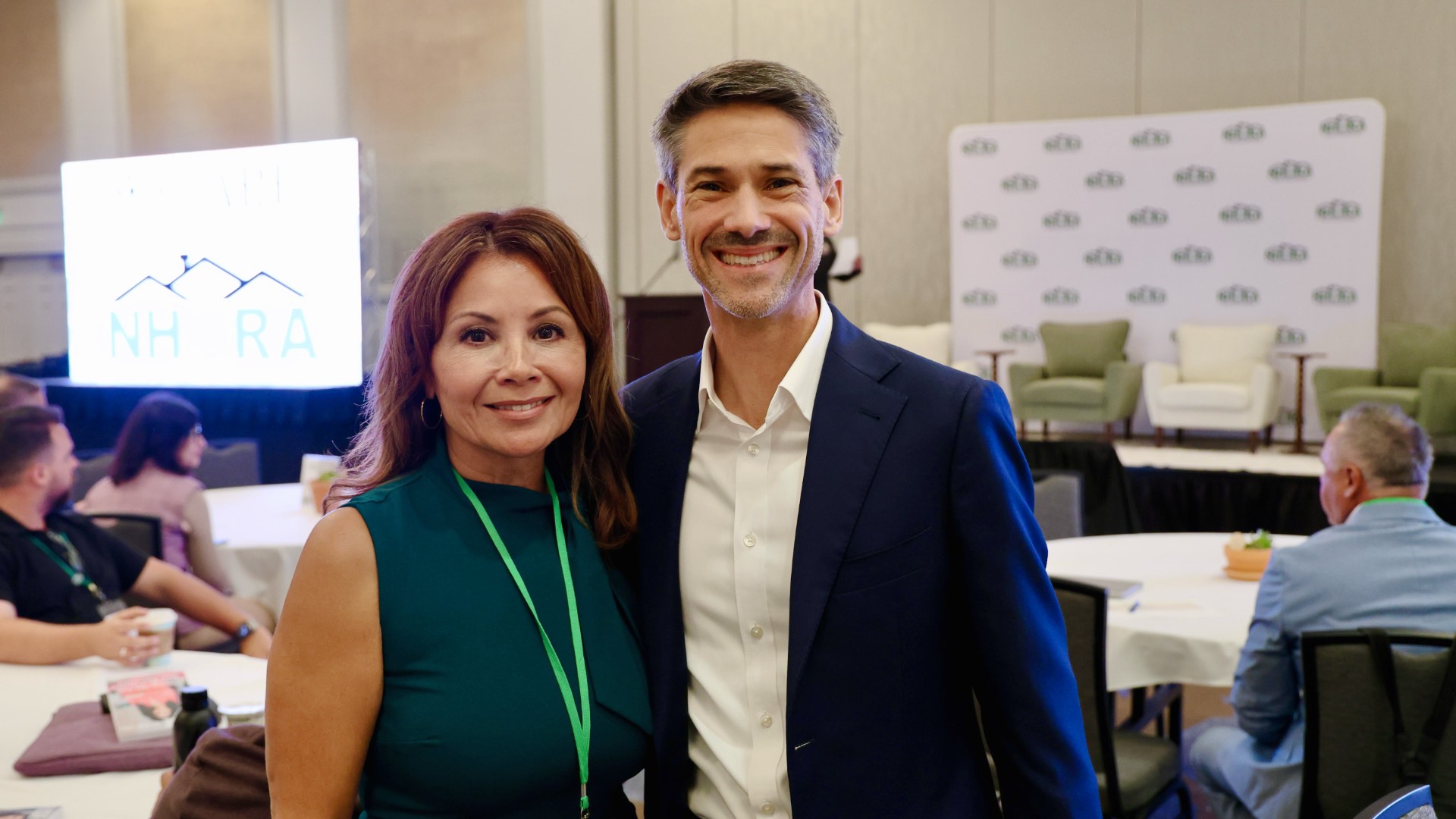
Michelle Juarez-Perry, National President of the National Hispanic Organization of Real Estate Associates (NHORA), with San José Mayor Matt Mahan during the NHORA Conference, held September 11, 2026, at Hayes Mansion in San José, California.

Building Across Income Levels

Mahan also challenged the idea that market-rate and affordable housing should always be viewed as separate conversations.

He argued that communities need additional housing across income levels and that new market-rate construction can create movement throughout the existing housing market as residents move from one home to another.

For the real estate professionals gathered at NHORA, that raises a larger question.

Increasing housing inventory matters, but where does homeownership fit into the equation?

Mahan acknowledged that much of the housing currently being developed in cities such as San José consists of rental properties. While rental housing remains an important part of the market, he said communities also need ways for people to gain an initial foothold in ownership and begin building equity.

One experiment underway in San José provides an interesting example.

A Different Entry Point Into Homeownership

In 2024, San José became the first California city to adopt provisions allowing qualifying accessory dwelling units, commonly known as ADUs, to be sold separately as condominiums. The policy followed changes in California law allowing cities to authorize such conversions.

The concept moved from policy to an actual home sale this year.

In June 2026, California’s first standalone ADU condominium sale closed in San José for $530,000. The newly constructed two-bedroom, one-bath home measures 749 square feet and includes private parking and separate utilities.

In Silicon Valley, where the cost of homeownership can put purchasing beyond the reach of many households, the sale represented something different: another potential entry point into the housing market.

Mahan referenced the sale during his NHORA remarks.

“It’s small, but it’s somebody’s home,” he said, emphasizing that the homeowner now has an asset in which they can build equity.

The example doesn’t solve the larger affordability challenge. But it demonstrates how one city is experimenting with different definitions of what an entry-level home can look like.

Creating More Choices

Mahan also pointed to San José’s efforts to streamline certain housing approvals, reduce development costs and encourage additional density around employment centers and transit.

The objective, he explained, is to give residents more choices about where and how they live while removing some of the obstacles that can prevent housing from being constructed.

Those efforts intersect with the work of many of the professionals attending the NHORA Conference.

Mortgage professionals, real estate agents, developers and housing advocates can help consumers navigate the path toward purchasing a home. But that pathway becomes increasingly difficult when available housing doesn’t exist at prices prospective buyers can realistically reach.

Housing supply, development, financing and homeownership are different parts of the same conversation.

A Conversation Bigger Than San José

Mahan closed his remarks by recognizing the real estate community as an important participant in efforts to increase housing production and expand opportunities for homeownership.

His comments offered a look at how one major city is approaching a challenge that extends well beyond Silicon Valley.

San José’s circumstances are its own. Its policies reflect the economics, housing market and political decisions of that community. Other cities will make different choices.

But the underlying questions aren’t unique to San José.

Across the country, communities continue to wrestle with how much housing to build, where to build it, what it costs to construct and whether working families will ultimately have an opportunity to own rather than rent.

There may not be a single answer.

San José provides one case study and an opportunity to examine what happens when a city begins experimenting with different ways of getting more homes built and creating additional pathways to ownership.

EDITOR NOTES 

This article is based on remarks delivered by San José Mayor Matt Mahan on September 11, 2026, during the NHORA Conference at Hayes Mansion in San José, California.

Mahan’s remarks have been edited and organized for clarity and length. Statements regarding housing production, development costs, housing policy and the effects of those policies are attributed to the mayor where appropriate. Information regarding San José’s residential development incentives and ADU condominium program was supplemented with publicly available information from the City of San José.

The article examines San José, California, as one example of how a major U.S. city is addressing housing supply and pathways to homeownership.

 

Meet Gina Saad and YourPersonal broker.com

Meet Gina Saad and YourPersonal broker.com

Meet Gina Saad and YourPersonal broker.com

A Legacy in Real Estate, A Vision for the Future


For more than 25 years, Gina Saad has dedicated her career to helping Californians achieve the dream of homeownership. A proud California native born in Brawley, raised in West Covina, and later a homeowner in Victorville at just 19 years old, Saad’s journey in real estate began early.

“My dad was a real estate broker. He got his license in 1975, so it was truly the family business,” she shared. “I earned my license at 18 and my broker’s license at 21. From the beginning, I had a passion for helping homebuyers attain the American dream.”

Over the years, Gina has held leadership positions in multiple real estate franchise brokerages, most recently serving as a managing broker for a large cloud-based firm overseeing thousands of agents across California. It was during this time she recognized a critical issue in the industry a training and comprehension gap affecting many new agents entering the field.

Bridging the Gap: YourPersonalBroker.com

“Many agents are launched into the industry without fully understanding the day-to-day contracts they need to work with,” Gina explained. “That’s why I created YourPersonalBroker.com to support brokers as they train and guide their agents.”

Unlike most tools that focus exclusively on agents, Gina’s platform centers on broker support.

“Sometimes a broker needs a broker,” she said. “Brokers are expected to do it all  lead, train, recruit, market, supervise. My goal is to give them back time in their day and provide a system that supports their agents 24/7.”

Your Personal Broker combines in-person training with AI-powered on-demand support through its proprietary ASK tool. This innovative platform allows agents to access  real-time forms clarity and professional communication support at any hour, addressing the reality that real estate doesn’t stop at 5 p.m.

Technology Meets Experience

“Brokers want to support their agents, but the truth is, time is scarce,” Gina noted. “If ASK can give brokers back even an hour a day or a week to focus on growing their business, recruiting, or marketing, then we’ve created something meaningful. It’s a time-saving partner for brokers and their agents.”

The ASK platform is fully web-based and accessible through yourpersonalbroker.com , integrating next-generation AI support with Gina’s hands-on approach.

Rooted in Community and Family

Gina lives with her family in Yucaipa, California. She credits her husband and three daughters for their unwavering support as she embarks on this new chapter.

“As a woman business owner, launching YourPersonal broker.com during Women’s Small Business Month is incredibly special,” she said. “I’m proud to build something that uplifts an industry I’ve loved my entire life.”

Connect with Your Personal Broker

Brokers and agents can visit yourpersonalbroker.com to sign up and explore ASK, or follow the company on YouTube, Instagram, Facebook, and TikTok at YourPersonalBroker.com or https://www.yourpersonalbroker.com/

About Gina Saad:


Gina Saad is a California real estate broker with more than 25 years of leadership experience. A second-generation real estate professional, she has overseen thousands of agents statewide and is passionate about bridging the training gap in the industry.

More Stories

Inland Empire Faith, Finance and Homeownership Summit

Inland Empire Faith, Finance and Homeownership Summit

ABOUT THE EVENT

Faith, Finance & Homeownership is a two-part convening focused on equipping our Inland Empire communities with tools to build and retain generational wealth. Through faith-based partnerships, financial coaching, and practical resources, the event connects families to pathways for stability and prosperity.

Presented by the Inland SoCal Housing Collective in partnership with Credit.org, BankOn Inland SoCal, Hispanic Lifestyle, and the National Foundation for Credit Counseling.

Event Overview

Morning Session (9AM–1PM)
Faith leaders, community organizations, and financial experts gather to explore:

  • Why financial education, homeownership, and estate planning are vital.

  • The role of faith partners in supporting families.

  • How to get started with financial coaching, safe banking, and debt management.

  • Building resilience through business ownership, housing stability, and church-led initiatives.

  • Strategies for homeownership and estate planning to retain generational wealth.

The session concludes with next steps, a resource fair, and a call to action for faith and community leaders.

Afternoon Session (1:30PM–4PM)
A broader regional convening highlighting solutions, collaboration, and action:

  • Why financial education and generational wealth matter for families and communities.

  • Access to safe banking and the support of faith coalitions.

  • Spotlight on organizations driving financial resilience, including housing counseling, small business development, and estate planning.

  • Closing discussion and survey to shape future work.

Who Should Attend

A peer to peer event, Faith, Finance & Homeownership is designed for faith leaders, community advocates, nonprofit partners, educators, housing professionals, small business owners, and residents of the Inland Empire who are passionate about building stronger, financially resilient families. This convening is ideal for anyone seeking practical tools to support their congregation or community in achieving financial stability, homeownership, estate planning, and generational wealth.

LOCATION
California Museum of Photography
(located historic downtown Riverside)
3824 Main Street • Riverside, CA 92501

PARKING
City of Riverside parking garages 2 and 6 are closest to the museum.

BE OUR GUEST
Please register today, space is limited.

Event Schedule

Wednesday - November 5, 2025

Morning Session - Faith Leaders

Registration

9am - 9:30am

Welcome & Our Why?

  • Claudio Espino– Intro Credit.org & answer- “Why financial education/coaching?” (5 minutes)
  • Richard Sandoval, Intro Hispanic Lifestyle- “Why building generational wealth? /Homeownership & Estate Planning?” (5 minutes)
  • Melanie Steele, ISCHC- Intro to ISCHC & BankOn Coalition- “Why faith partners?”  (5 minutes)

9:30am - 10am

Blessing: Dr. Joshua Beckley

Panel One: How to get started?

Goal: Discuss the initial steps A). Faith leaders know what the steps are B). What resources exist in the community, C). How to refer community members  

  • Financial Coaching, Budgeting, Debt Management, Climb-

 Claudio Espino, Credit.org 

  • Banking Access 

Jay Miller, BankOn Coalition Lead at ISCHC

    • Overview of access to safe banking.
    • Demonstrate Banking Tool  pick an attending church address and look up the nearest branch

10:00am

Panel Two: A Movement of Building Wealth

Goal: Amplify regional organizations who are helping build the financial resilience of their community. 

  • Building Generations in a Church-
  • Building a Business- What is the impact on a family when they build a business? 
  • Building Housing Stability – How do we help our counties become financial stable in this housing crisis 

10:30AM- 11:05AM

Panel Three: Building and Retaining Generational Wealth

Goal: What is the impact of homeownership on a family and generations? How is this wealth retained? 

  • Homeownership Month What is the impact on a family who owns a home?, Home Mortgage Tools
  • Why homebuyer counseling- Melinda Opperman- Credit.org/ISCHC Board Member- How do you get started? 
  • How do you get started buying a home? – How do you get started with buying a home? How long can it take? What tools can be used?  Down payment assistance programs available? 
  • Retaining Generational Wealth- Estate Planning, Why is it important? Where do you go for help?  

11:05 AM - 11:45am

What is to come? Next Steps

Goal: What is the impact of homeownership on a family and generations? How is this wealth retained? 

  • Homeownership Month –What is the impact on a family who owns a home?, Home Mortgage Tools
  • Why homebuyer counseling- Melinda Opperman- Credit.org/ISCHC Board Member- How do you get started? 
  • How do you get started buying a home?  – How do you get started with buying a home? How long can it take? What tools can be used?  Down payment assistance programs available? 
  • Retaining Generational Wealth- Estate Planning, Why is it important? Where do you go for help?  

11:45AM - 12PM

Lunch and Small Resources Fair

12PM - 1PM

Wednesday - November 5, 2025

Afternoon Session - Community Stake Holders

Welcome & Why financial education and generational wealth matter.

  • Claudio Espino (Credit.org): Why financial education/coaching
  • Richard Sandoval (Hispanic Lifestyle): Why building generational wealth through homeownership & estate planning
  • Melanie Steele (ISCHC): Why this matters regionally, what happened with faith leaders in the morning, and how to join the movement.

2:00PM – 2:30PM

Panel One: What’s the Scoop - Understanding the Landscape


Goal: Provide an overview of regional challenges and opportunities around financial access and community resources.

  • Jay Miller (ISCHC, BankOn Coalition Lead): Access to safe banking + demo of banking locator tool.
  • Pastors United :  How faith coalitions support families with resources like food, utility support, and school supplies.

2:30PM – 3:00PM

Panel Two: Where is the Work Being Done – Spotlight on Solutions


Goal: Amplify organizations already advancing financial resilience and generational wealth, and explore collaboration across sectors.

3:00PM - 3:45pm

Discussion: Closing & Survey

3:45PM - 4:00pm